Moon's Transformative Geological Changes: Witnesses of a Celestial Sculpting
From tranquil clouds of dust to brooding regions of basalt, the Moon reveals herself not as the static, bygone body she appears to be, but as a vibrant record of cosmic evolution. Her surface transformations over the eons offer clues about our own planet and the early dynamics of the Solar System—a silent witness to celestial events spectacular beyond imagination.
Journey to the Beginning: A Molten Past
Approximately 4.5 billion years ago, the Moon was born in violence, the likely outcome of a titanic collision between a young Earth and a Mars-sized body—a scenario poetically termed the giant-impact hypothesis. Initially, this newborn satellite was a hot, molten mass floating much closer to Earth. Tidal forces due to this proximity sculpted it into an ellipsoid, a squashed sphere with its long axis always pointing Earthward.1
As the fiery ocean of lava cooled, a fascinating process unfolded. Heavier elements, like iron, sank to form a core, while lighter elements floated to the top forming the lunar crust, primarily consisting of igneous rocks like anorthosite and basalt.2 About 100 million years into its infancy, the Moon became tidally locked with Earth—a cosmic choreography that means we see only one side of it, adding to its mysterious allure.3
Sculpted by Violence: Impact Craters and Volcanism
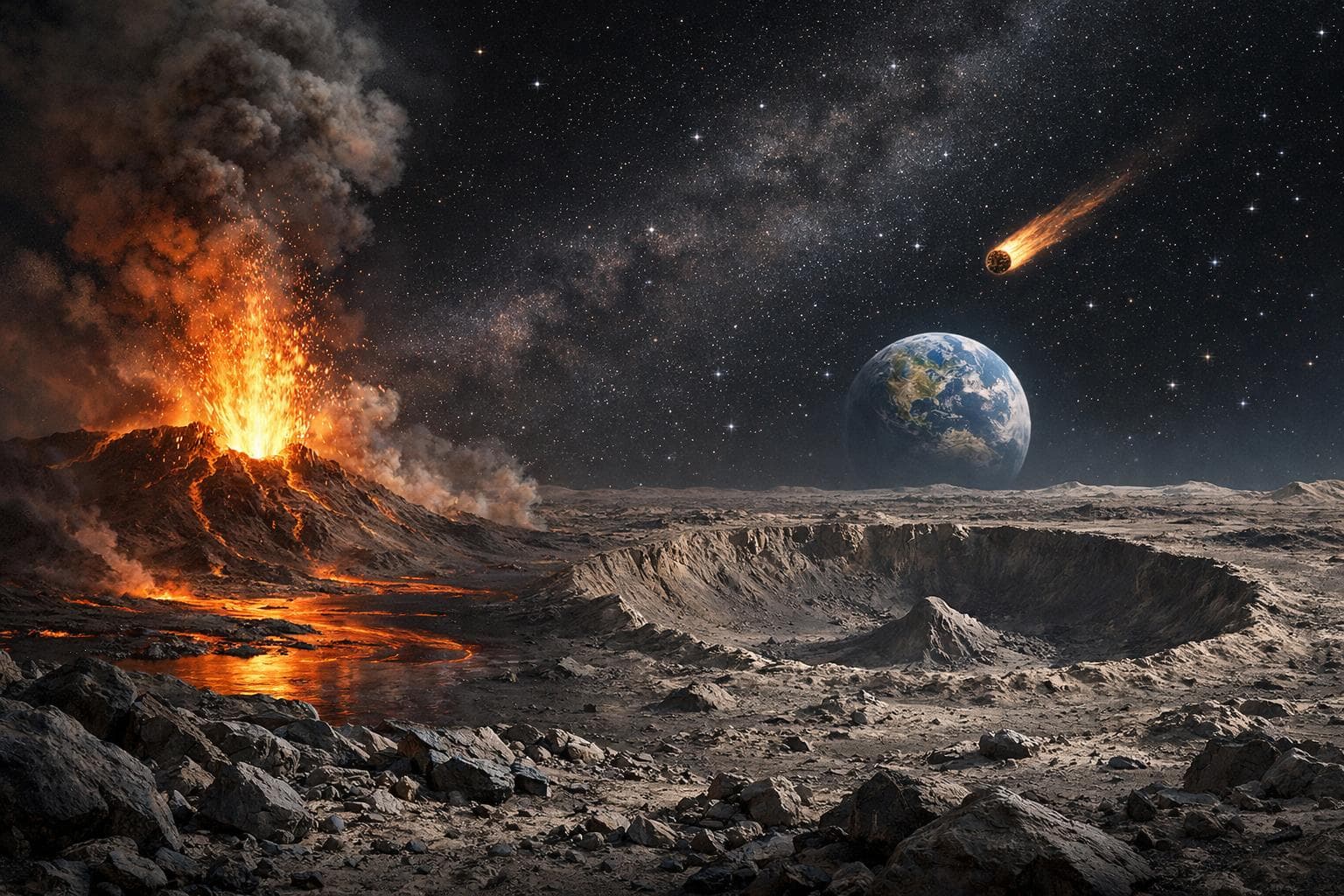
The Moon's geological history is dominated by periods of intense bombardment of asteroids and comets—a process that left her face pockmarked with craters upon impact. These craters range from the tiny, simple bowl-shaped Guinevere's to the vast, ringed basin of Imbrium. This impact history helps scientists piece together the timeline and intensity of meteor activity in the Solar System’s past.45
But the Moon’s geological narrative involves more than just impacts. Enter volcanism—the Moon's inner forge. As radioactive elements such as uranium and thorium heated the mantle, pockets of magma formed and occasionally erupted onto the surface. This created expansive plains of basalt known as lunar maria, predominantly on the near side of the Moon.6 These seas of cooled lava are more than aesthetic landforms; they record volcanic activity from about 3 to 1 billion years ago, marking a period of significant internal activity.
Why It Matters: Unlocking the Secrets of the Solar System
Why should these ancient geological tales captivate us today? The Moon serves as a tangible record of Earth's formative years that were erased by erosion and tectonics. Understanding lunar geology helps scientists decode the early history of the Earth-Moon system, providing insights into planetary processes such as volcanism and impact cratering that are still shaping worlds across the universe.
The Moon’s lack of atmosphere means it hasn’t altered much over eons—a time capsule in orbit. It becomes a crucial reference point for identifying similar features elsewhere and estimating the age of planetary surfaces in the Solar System. These studies directly influence our strategies for future explorations, including human bases or robotic explorations on hostile terrain.
Gazing Forward: The Moon as a Stepping Stone
The more we learn about lunar transformations, the more they seem not just historical, but thrilling preludes to the next chapters of space exploration. Returning to the lunar surface with missions like NASA's Artemis, we're set to explore untouched terrains that hold cosmic secrets waiting to be unraveled. As scientists devise sophisticated robotic missions and plan human bases, each step forward might well redefine what we know about planetary science.
Indeed, the Moon's solidified lava flows and pockmarked plains may tell a story millions of years old, but it is a story that promises fresh chapters in humanity’s exploration of the universe. These transformative geological changes on the Moon are not just echoes of a turbulent past; they are guides lighting the way to understanding our future among the stars.
Footnotes
-
Source: YouTube - The Geologic History of the Moon Explained ↩
-
Source: ScienceDirect - Geology, geochemistry, and geophysics of the Moon: Status of current understanding ↩
-
Source: Raleigh Astronomy Club - Geologic Processes on the Moon ↩
-
Source: Nature Communications - Geologic evolution of the Moon studied through young lunar basaltic volcanism ↩