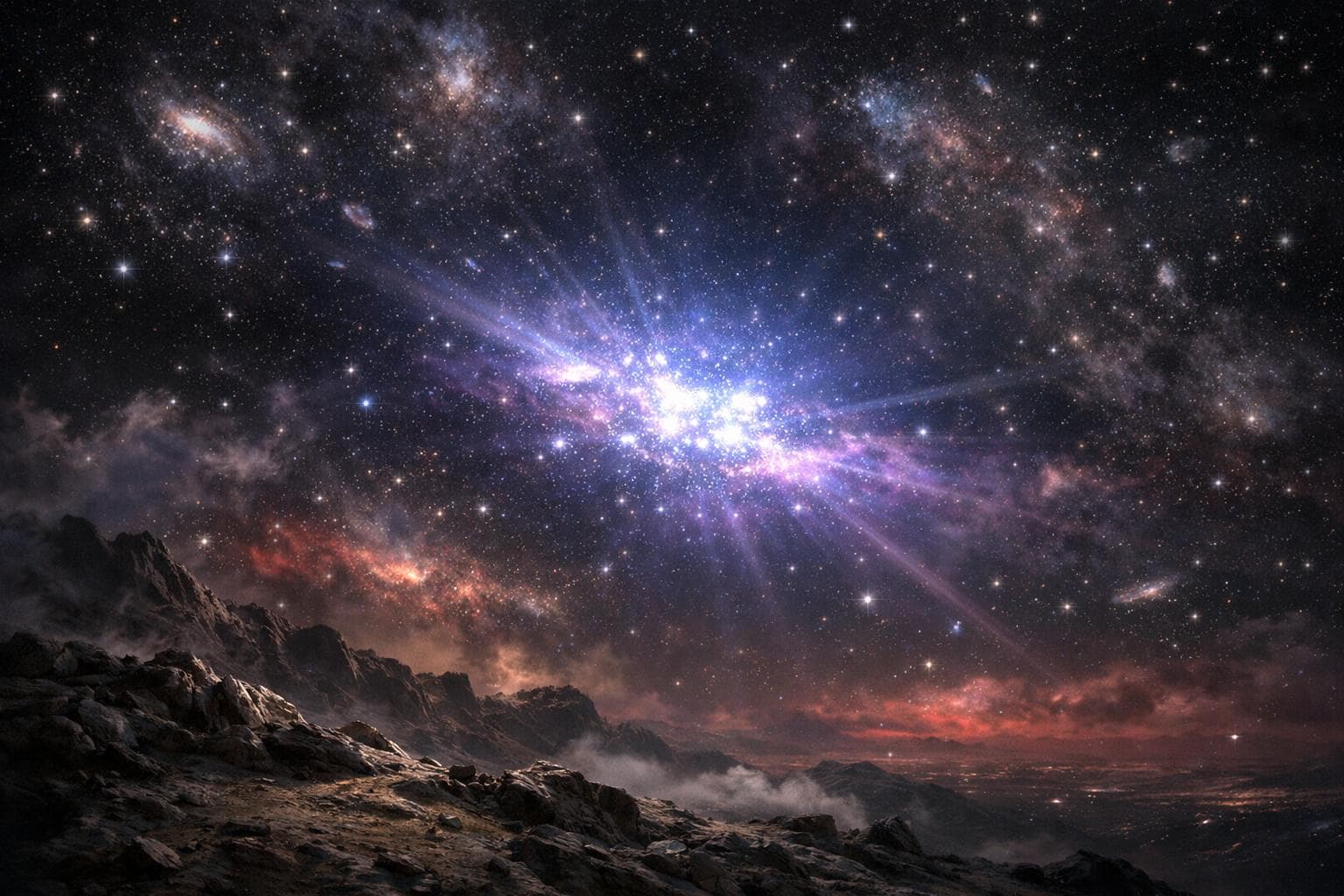
Ultraviolet Glimmers from the Early Universe: A Galaxy's Ancient Light Illuminates Cosmic History
Imagine peering into a time machine, one so powerful it allows us to glimpse the universe not long after its explosive inception. This fantasy is reality for astronomers using the Hubble Space Telescope, who have just unveiled a treasure trove of ultraviolet light from a galaxy that emerged a mere 1.4 billion years after the Big Bang. This ancient galaxy, dubbed MXDFz4.4, is not just a cosmic relic but a key to unlocking secrets about the universe's transformative early period.
Background: The Young, Expanding Cosmos
In the vast timeline of the cosmos, 13.8 billion years stretch out like an unfathomably long scarf knitted with the stars and galaxies we've come to know. MXDFz4.4 formed in the universe's adolescence—during a pivotal era astronomers affectionately term the Era of Reionization. This epoch, lasting from about 400 million to 1 billion years post-Big Bang, was a transformative epoch during which the first luminous structures, like stars and galaxies, emerged to clear away the cosmic fog of neutral hydrogen.
The Science: Unlocking Ultraviolet Mysteries
So why does the discovery of ultraviolet light leaving MXDFz4.4 matter? The revelation that ultraviolet (UV) light, specifically ionizing radiation from this galaxy, can escape offers a profound insight into the universe’s evolutionary track. Ionizing radiation is a high-energy form of light that can strip electrons from atoms, turning them into ions. This capability is particularly pertinent because it suggests that MXDFz4.4, and others like it, contributed substantially to reionizing the universe, effectively lighting up the dark cosmos and shifting the veil that shrouded the early cosmic landscape.
This galaxy, only 1.4 billion years old when its light started the cosmic journey towards us, hosts clusters of young, hot stars teeming with energy. These stars produce ionizing ultraviolet light potent enough to transform the opaque gas within and around MXDFz4.4, gradually highlighting it against the cosmic backdrop.
A key process at play is the cosmological redshift. As light travels across the expanding universe, its wavelength stretches, transitioning from ultraviolet and visible spectra into infrared. This shift means MXDFz4.4’s ultraviolet emissions have navigated through space and time to arrive at us in altered form, long after their birth in fiery, young-star clusters.
Why It Matters: Peering into Cosmic Construction Sites
Discoveries like the ultraviolet emissions from MXDFz4.4 help us reconstruct the universe’s early chapters. Understanding how primordial galaxies contributed to cosmic reionization aids astronomers in piecing together how galaxies, stars, and ultimately us, came to be. The information from MXDFz4.4 reveals that early galaxies played more active roles as cosmic step-mothers, nurturing and sculpting their neighborhoods through intense radiation.
This knowledge bridges critical gaps in the timeline of the cosmos. It provides clues to the conditions and processes that allowed the universe to evolve from a hot, dense space to the complex and structured cosmos we explore today.
What's Next: Expanding Our Gaze
The observation of MXDFz4.4 paves the way for more discoveries. With the James Webb Space Telescope now operational, poised with capabilities tailored to sniff out such ancient relics in the infrared spectrum, we are set to delve even deeper into the timeline of the cosmos. This incredible technological tandem offered by Hubble’s pioneering discoveries and Webb’s advanced observational fidelity promises to reveal yet more about those ancient days of universal formation.
Ultimately, these discoveries underline a profound truth: the universe, with all its past still pouring light into our instruments across unfathomable distances, continues to speak about its history, waiting for us—curious and ever-persistent souls—to listen and learn.
As we look forward, the imagination kindled by these insights will certainly continue to inspire future explorers. Who knows what tales yet remain in the form of light, crisscrossing the cosmic seas, awaiting our attentive eyes and boundless curiosity?